

What is patient-centred consensus?
Patient-centred consensus is consensus-led evidence built with the patient voice at its centre. Most structured consensus work captures the expert clinical view: what specialists agree on, and where practice should move. Patient-centred consensus complements that by putting the lived experience of patients into the evidence itself – how a condition, a care pathway or a guideline actually plays out for the people it affects.
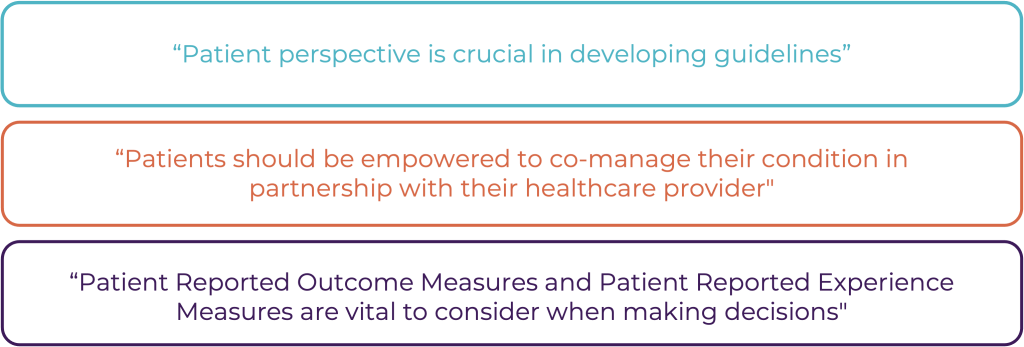
That perspective is carrying more weight than it used to. Regulators and health technology assessment bodies increasingly expect patient-centred evidence, and medical affairs teams recognise the need to gather insights directly from patients rather than inferring them from clinical endpoints alone.
For teams building a case for change – a pathway redesign, a guideline revision, a new standard of care – patient-centred consensus provides the dimension of evidence that clinical opinion alone cannot: what the change means for the patients living with its consequences.
When the patient voice belongs in the evidence
Patient-centred consensus earns its place when the question cannot be fully answered by clinical expertise alone. It is typically the right approach for:
Understanding real-world impact. How a guideline, treatment approach or service configuration actually works for patients – the friction, trade-offs and outcomes that sit behind the clinical measures.
Demonstrating unmet need. Where the strongest evidence of a gap is the patient experience itself: delayed diagnosis, fragmented pathways, burdens of treatment that clinical data records only indirectly.
Building a case for change that decision-makers act on. Payers, policy-makers and guideline committees weigh the patient dimension alongside expert opinion; evidence that carries both is harder to set aside.
Meeting the expectations of regulators and HTA bodies. As patient-centred evidence becomes an expectation rather than a differentiator, consensus work that integrates the patient voice keeps a submission or strategy aligned with where assessment is heading.
How it relates to our other consensus methods
Triducive’s structured consensus methods – the Delphi panel and the Delphi method behind it – produce a measured, defensible position from expert clinical agreement.
Patient-centred consensus centres the evidence on patient experience and priorities instead, and the two perspectives often strengthen each other: a case for change is most persuasive when it can show both what the experts agree should happen and what it means for patients when it does.
Which structure fits and how the patient voice is best integrated for your specific question is agreed at scoping. Explore the full range on our consensus services page.
How Triducive runs patient-centred consensus
Triducive designs and facilitates consensus-led evidence across the full range of methods, matching the approach to the question rather than fitting every question to one template. As independent facilitators, our team scopes the question, designs the right way to capture the perspectives that matter (including the patient voice where it belongs at the centre) and ensures the findings are communicated so they support real change.
The patient voice in practice: standards of care in von Willebrand disease
Von Willebrand disease (VWD) suffers from low awareness among healthcare professionals and a significant gender bias in care delivery, which heavily impacts women’s health and quality of life. To gather patient perspectives on how standards of VWD care could be improved and delivered equitably across the UK and Ireland, a steering group of seven VWD patient advocates designed a survey of 41 statements across five key areas, using a modified Delphi consensus method with a consensus threshold of 75%.
Fifty-six responses were analysed. All 41 statements met the consensus threshold: 39 (95%) achieved very strong consensus and 2 (5%) strong consensus. From these insights, the steering group established 10 patient-focused recommendations to elevate the standards of VWD care.