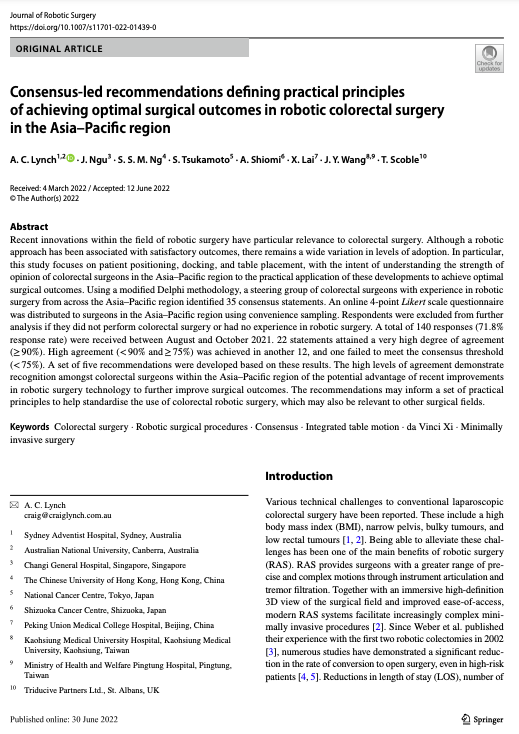


Robotic surgery helps overcome well-known challenges in laparoscopic colorectal surgery, including operating on patients with a high BMI, a narrow pelvis, or bulky and low rectal tumours. Adoption still varies widely, because colorectal procedures span multiple quadrants of the abdomen and often force surgeons to improvise port placement, switch between laparoscopic and robotic approaches, or redock mid-procedure. That variation feeds through into differing outcomes.
To define best practice, a steering group of seven colorectal surgeons across the Asia-Pacific region developed 35 statements across four themes, covering surgical challenges, good practice, table integration and training. The statements were tested through a modified Delphi consensus, with an online survey completed by 140 surgeons in six countries, a response rate of 71.8%. Agreement was pre-specified at 75%.
Thirty-four of the 35 statements reached consensus, 22 of them at very high agreement of 90% or above. The recommendations centred on standardising technique and making full use of the robotic system, including using Integrated Table Motion where available to improve operating room efficiency, team communication and patient outcomes.
Triducive acted as the independent facilitator for this Delphi consensus study, analysing the responses to produce an agreement score for each statement. The recommendations offer a set of practical principles to help standardise robotic colorectal surgery.
Lynch AC, et al. Journal of Robotic Surgery, 2023; 17(2): 457–463. DOI: 10.1007/s11701-022-01439-0