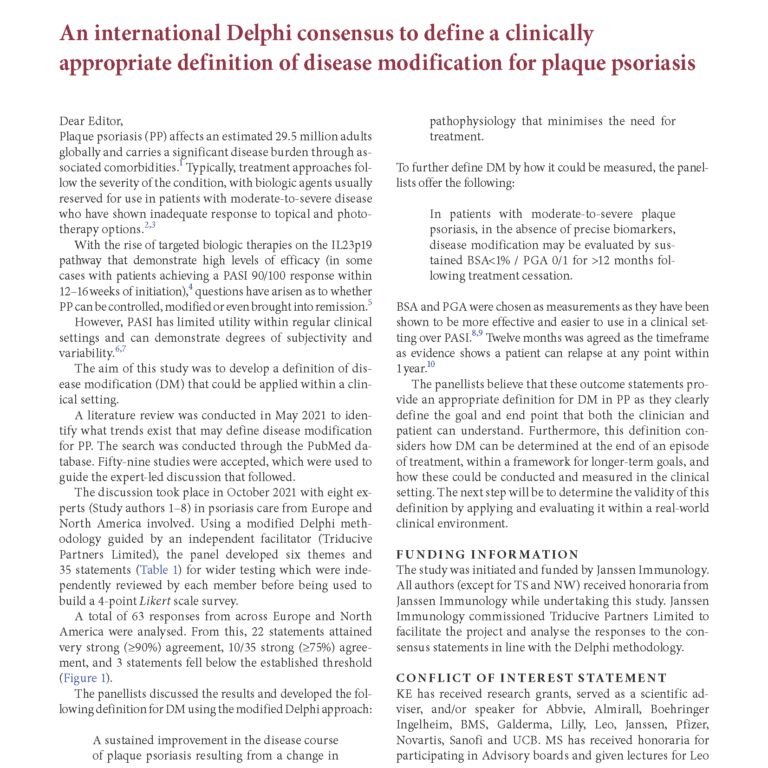


Plaque psoriasis affects an estimated 29.5 million adults worldwide and carries a heavy burden through its associated comorbidities. A newer generation of highly effective biologics can now clear skin for many patients within a few months, which has raised a harder question: can the disease itself be modified, rather than only its symptoms controlled? Until recently there was no definition of disease modification that a clinician could actually apply in practice.
To build one, an international panel of eight psoriasis experts from Europe and North America reviewed the literature and developed 35 statements across six themes, from the role of treatment and time to the place of biomarkers. The statements were tested through a modified Delphi consensus, using a survey completed by 63 specialists, with strong agreement set at 75% and very strong agreement at 90%.
Twenty-two of the 35 statements reached very strong agreement. The panel agreed a working definition of disease modification as a sustained improvement in the course of the disease that stems from a change in its underlying biology and reduces the need for treatment. There was unanimous agreement that disease modification should be the future goal for new psoriasis therapies.
Triducive acted as the independent facilitator for this modified Delphi consensus, generating the statements and analysing the responses. The resulting definition gives clinicians and researchers a shared endpoint to work towards and to test in real-world practice.
Eyerich K, et al. Journal of the European Academy of Dermatology and Venereology, 2024; 38(5): e424–e427. DOI: 10.1111/jdv.19652