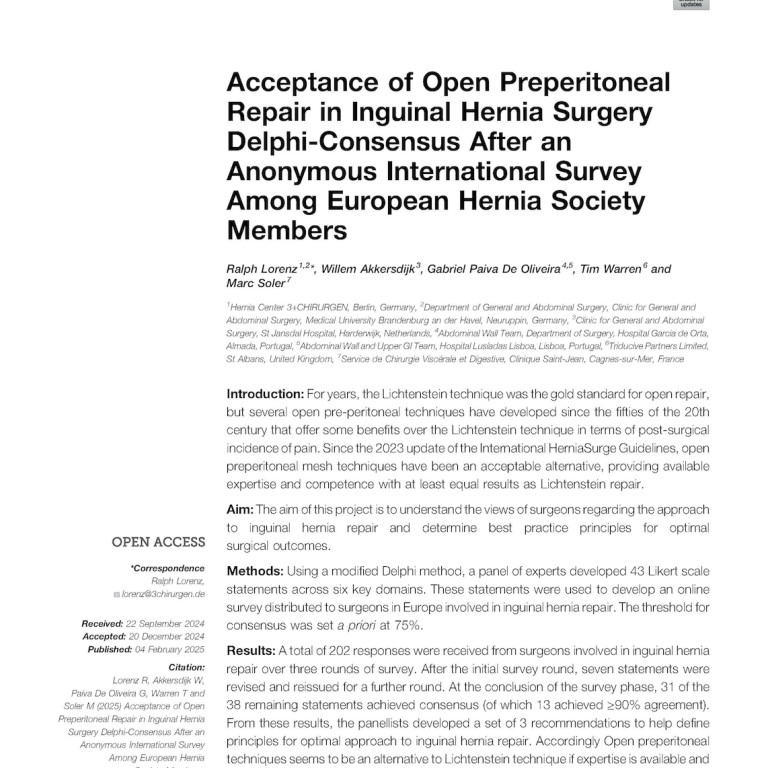


The Lichtenstein technique remains the most widely used open inguinal hernia repair, valued for being simple and reproducible, but concerns persist over chronic post-surgical pain, reported in up to 10 to 12% of cases. Open preperitoneal alternatives aim to match its simplicity while reducing that pain, yet comparative trial evidence is limited, so the choice of technique often comes down to a surgeon’s own experience.
To establish where European surgeons agree on best practice, a steering group developed 43 statements across six domains, from patient selection to education. The statements were tested through a three-round modified Delphi consensus: an anonymised survey of European Hernia Society members followed by a retest of revised statements. Agreement was pre-specified at 75%. In total, 202 surgeons from 27 European countries took part.
Thirty-one of the remaining 38 statements reached consensus, 13 of them at 90% or above. Agreement was highest on education, with unanimous support for the view that knowledge of anterior and posterior surgical anatomy is crucial to future training. The recommendations position open preperitoneal techniques as genuine alternatives to Lichtenstein where the expertise exists, within a tailored approach to groin hernia surgery.
Triducive acted as the independent facilitator for this Delphi consensus programme, designing and running the methodological process. Acceptance of these techniques, the panel concluded, depends primarily on surgical expertise and training.
Lorenz R, et al. Journal of Abdominal Wall Surgery, 2025; 3: 13840. DOI: 10.3389/jaws.2024.13840