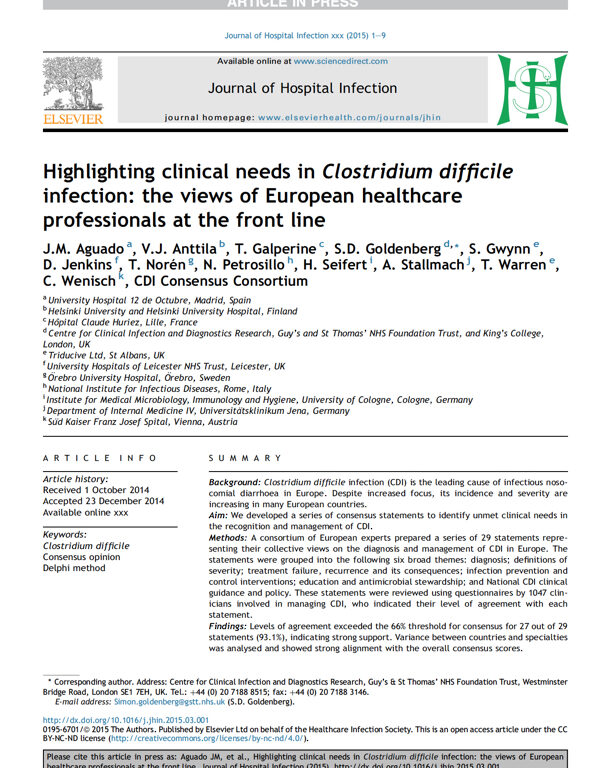


Some of the most serious infections in European hospitals are also among the hardest to manage consistently. One such healthcare-associated infection, a leading cause of infectious diarrhoea acquired in hospital, has been rising in both incidence and severity across many European countries, yet recognition, diagnosis and treatment still vary widely between centres and specialties.
To identify where the gaps lie, a consortium of European experts developed 29 consensus statements across six themes, spanning diagnosis, definitions of severity, treatment failure and recurrence, infection prevention and control, education and antimicrobial stewardship, and national guidance. The statements were then reviewed through a structured Delphi consensus by 1,047 clinicians involved in managing the infection, one of the largest respondent groups behind any consensus in this collection, with agreement set at 66%.
Twenty-seven of the 29 statements reached consensus, and agreement showed strong alignment across both countries and specialties. On that basis the group set out recommendations for developing services to reduce transmission and recurrence, and to make appropriate diagnosis and treatment consistent across all healthcare settings.
Triducive supported this consensus process, contributing to its facilitation and analysis. The result is a clear, expert-backed picture of where clinical practice needed to improve across Europe.
Aguado JM, et al. Journal of Hospital Infection, 2015; 90(2): 117–125. DOI: 10.1016/j.jhin.2015.03.001