


Delphi Panel Size: How Many Experts Should Be on a Delphi Panel?
One of the most common questions when planning a Delphi study is:
“How many experts do we need on the panel?”
Determining the appropriate Delphi panel size in a Delphi study is an important design decision. The answer is not as straightforward as many researchers expect.
Unlike clinical trials or quantitative surveys, the Delphi method is built around informed expert opinion rather than statistical representation. The objective is not to estimate the views of a wider population, but to bring together experts with the knowledge and experience to develop consensus where evidence is limited, conflicting, or still emerging. As a result, the quality of the panel is often more important than the number of participants.
For that reason, there is no universally accepted “correct” Delphi panel size. Instead, the number of experts should reflect the aims of the study, the complexity of the clinical question, and the diversity of perspectives needed to produce meaningful consensus.
Why Delphi Panel Size Can Matter
Choosing the right Delphi panel size is an important part of designing a robust Delphi study.
A panel that is too small may not capture the full range of clinical opinion, particularly if the topic spans several specialties or healthcare settings. On the other hand, recruiting an unnecessarily large panel can increase costs, lengthen timelines, and make it more difficult to maintain engagement throughout multiple rounds of questionnaires.
The most robust Delphi studies strike the right balance between obtaining diverse expert perspectives and maintaining a manageable, engaged panel. Rather than focusing on maximising participant numbers, researchers should aim to recruit enough experts to provide credible, well-rounded insight while ensuring that every participant can make a meaningful contribution throughout the study.
There Is No Magic Number When It Comes to Choosing Experts for a Delphi Panel
One of the strengths of the Delphi methodology is its flexibility.
Published Delphi studies have included panels ranging from fewer than ten participants to over two hundreds experts. This wide variation does not suggest inconsistency in the methodology itself, but rather reflects the different questions researchers are trying to answer.
A consensus project investigating a highly specialised rare disease may only have access to a relatively small pool of internationally recognised experts. In these situations, a panel of 8 to 20 participants may represent a substantial proportion of the global expertise available. By contrast, studies addressing broader healthcare policy or multidisciplinary clinical pathways may require considerably larger panels to ensure that all relevant perspectives are represented.
The key consideration is not whether a study includes 20, 40 or 200 experts. It is whether the selected panel possesses the expertise necessary to address the research question with authority and credibility.
Expertise Is More Important Than the Number of Experts in a Delphi Panel
Perhaps the biggest misconception about Delphi studies is that recruiting more participants automatically leads to stronger results.
In reality, the opposite can sometimes be true. The value of a Delphi panel comes from the quality of its members rather than its size. Participants should be selected because they have recognised experience within the subject area, whether through clinical practice, research, guideline development, academic leadership, or extensive experience managing the relevant patient population.
A carefully selected panel of experienced specialists is far more valuable than a much larger group with varying levels of knowledge or limited exposure to the topic under discussion. Every participant should have a clear reason for being included and should be able to provide informed opinions throughout each round of the study.
It is worth noting that modern healthcare is often multidisciplinary, so Delphi panels should include experts from relevant professions when their perspectives contribute to the research question. Bringing together different specialties helps produce recommendations that are both clinically robust and practical while reducing discipline-specific bias.
However, panel diversity should always be guided by the study’s objectives, with participants chosen for the value of their expertise rather than representation alone.
Statistical Considerations When Choosing Delphi Panel Size
One of the reasons there is no standard Delphi panel size is that Delphi studies differ fundamentally from statistical research.
Traditional sample size calculations are designed to estimate treatment effects or measure outcomes across large populations. By contrast, Delphi methodology seeks to understand where informed experts agree, where opinions differ, and how consensus develops through structured feedback.
As a result, methodological quality depends less on the number of participants and more on the overall study design. Clearly defined inclusion criteria, well-written survey statements, predefined consensus thresholds, and high response rates across multiple rounds all contribute more to the credibility of the findings than simply recruiting more experts.
While larger Delphi panels can capture a broader range of perspectives, they also increase recruitment, administrative, and analytical demands and may result in higher participant attrition. Researchers should therefore aim for a panel size that balances diversity of opinion with practical study management.
For studies intended to inform practice across different healthcare systems, including experts from multiple countries can strengthen the relevance and applicability of the findings by capturing variations in clinical practice and healthcare delivery.
So, How Many Experts Are Enough in a Delphi Panel?
The optimal delphi panel size should always be determined by the research question rather than by a predefined numerical target. Although many healthcare Delphi studies include between 15 and 30 experts, highly specialised studies may only require a relatively small group of internationally recognised specialists, while broader projects involving multidisciplinary care, national policy, or international clinical guidance often benefit from larger panels that capture a wider range of perspectives.
Rather than asking whether a Delphi panel is simply large enough, researchers should consider whether it includes the right expertise, relevant specialties, and appropriate geographical representation.
Typical Delphi Panel Sizes in Healthcare (‘a general rule of thumb’)
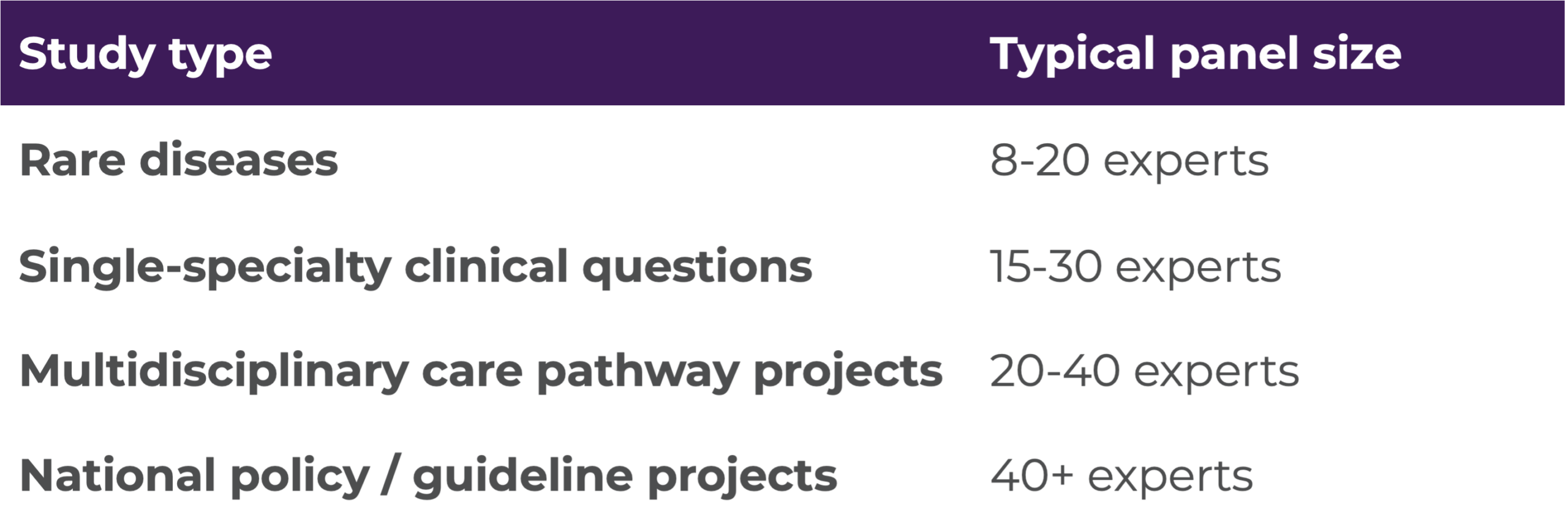
N.B. This ‘rule of thumb’ provides a useful starting point but the panel size should always be determined by the scope and objectives of each study.
Considering Project Objective when Deciding Delphi Panel Size
The “right” Delphi panel size often depends on what decisions the consensus is intended to support. A rare disease consensus project may rely on a relatively small group of recognised international experts, whereas studies designed to optimise treatment pathways, establish clinical recommendations, or support guideline development often require broader multidisciplinary representation.
The same principle applies to Medical Affairs, HEOR, and Market Access programmes. Whether the objective is to identify patient-relevant outcomes, prioritise treatment benefits, quantify unmet need, or generate evidence to support HTA submissions, the greatest determinant of study quality is usually the relevance of the experts involved rather than the total number recruited. The most successful Delphi studies combine sufficient breadth of expertise with participants who can provide informed, real-world perspectives that translate into meaningful and actionable consensus.
Finally…Remember to Recruit for Attrition
Delphi studies often involve two or more rounds of questionnaires. While recruitment may begin with 25 experts, some participants may not complete every round. For this reason, panel size decisions should account for expected attrition and aim to maintain sufficient participation throughout the study.
Key Takeaways
✓ There is no universally accepted Delphi panel size
✓ Expertise matters more than numbers
✓ Most healthcare Delphi studies include 15–30 experts
✓ Rare disease studies often succeed with smaller panels
✓ Maintaining engagement across rounds is more important than recruiting excessive numbers
About us
At Triducive we deliver consensus-led evidence that gets published and supports change, collaborating with medical affairs and other teams in life sciences around the world.
Triducive has delivered more than 130 healthcare Delphi consensus studies across multiple therapeutic areas, supporting publications, guideline development, market access strategies and evidence generation programmes.
Whether you need support with study design, expert recruitment, survey development or publication planning, our team can help.
Contact us to discuss your project.